
NeuroSense Therapeutics (NRSN) — Scientific Deep Dive for PrimeC and Pipeline Products
Executive Summary
The Hook. PrimeC is an extended-release, fixed-dose oral combination of two off-patent generics — ciprofloxacin (a fluoroquinolone antibiotic repurposed as an iron chelator / microRNA modulator) and celecoxib (a COX-2 inhibitor for neuroinflammation) — that in a 68-patient Phase 2b became the first randomized trial to show a treatment-associated reduction in TDP-43, the protein aggregate found in >97% of ALS cases.
The Bull Case. ALS is a terminal disease with essentially no disease-modifying standard of care and drug pricing of ~$150,000–$200,000/year (Radicava/edaravone ~$171,000; Qalsody/tofersen ~$199,200) — a management-estimated >$1B annual opportunity. PrimeC has a genuine peer-reviewed data package — the PARADIGM results were published in JAMA Neurology (Cudkowicz et al., 2026, DOI 10.1001/jamaneurol.2026.0230) — showing ~33–36% slowing of ALSFRS-R decline at 18 months (p=0.007), a ~15-month median survival separation, FDA-and-EMA orphan designation, FDA clearance for the Phase 3 PARAGON trial, and a Health Canada early-approval (NOC/c) path. If PARAGON replicates even half of PARADIGM, an oral, cheap-to-make disease-modifier in an empty market is a multi-hundred-million-dollar franchise against a ~$26M market cap.
The Bear Case. This is a $0.2 million-in-the-bank, going-concern nano-cap trying to run a ~300-patient global Phase 3 that will cost tens of millions it does not have and cannot raise at $0.75 without catastrophic dilution — the company just authorized a jump to 200 million shares. Its “binding term sheet” with a global pharma collapsed in March 2026. And the entire thesis is the exact structural setup that just failed spectacularly: Amylyx’s Relyvrio (AMX0035), another repurposed oral ALS combo with a striking small-trial survival signal, cleared FDA on a 137-patient Phase 2 and then flunked its 664-patient Phase 3 (PHOENIX) and was pulled from the market in April 2024. PrimeC’s pre-specified 6-month clinical endpoint actually missed (p=0.12).
Bottom Line. The science is legitimately interesting and peer-reviewed — but the balance sheet is near-terminal, the IP is thin, and the drug is running the Relyvrio playbook one trial behind. The equity is a financing-and-delisting story before it is a science story. Pass, with a tripwire (below) that could move it to Watch List.
Catalyst Calendar & Financial Runway
Upcoming Catalysts (next 12–18 months)
PARAGON Phase 3 first-patient-in — guided to H2 2026, contingent on financing. 300 patients, 2:1 PrimeC:placebo, 48-week double-blind + 48-week OLE, Bayesian adaptive design, ~15 sites across US/EU/Israel. Primary endpoint: ALSFRS-R progression rate over 48 weeks, adjusted for mortality — a clinical endpoint, not the TDP-43 biomarker that headlined June.
Health Canada NOC/c (Notice of Compliance with Conditions) — pre-NDS meeting contemplated April 2026; potential NDS submission by mid-2026 for early conditional approval in ALS. This is the most realistic near-term value event, though Canada is a small market and NOC/c is conditional.
Alzheimer’s next-study design — the RoAD proof-of-concept readout is done (June 25, 2026); any “adequately powered” AD study is design-stage only.
The Dilution Gap — this is not a gap, it’s a chasm.
As of December 31, 2025 the company held $0.2 million ($166K) in cash against a net loss of ~$11.1 million and ~$7.67 million of cash used in operations for FY2025 — roughly $640K/month of burn. The auditors carry a going-concern qualification and state existing cash “will not be sufficient to fund the Company’s operations for a period of at least 12 months”.
Financing is hand-to-mouth: a JonesTrading ATM (up to $14.2M capacity; ~$3.6M drawn in 2025, ~$0.99M since year-end), a $30M Yorkville (YA II) standby equity line, a $0.5M September 2025 private placement at $1.50, and — post-filing — a $600K PIPE at $0.80 in mid-2026 that the CEO, CFO and one existing investor had to backstop $200K each. On March 10, 2026 shareholders approved raising authorized capital by 110 million to 200 million ordinary shares — you don’t authorize 200 million shares against a 35-million-share base unless you intend to use them.
A raise is not “likely before the next data drop”; it is continuous and existential. Funding a global Phase 3 from a $26M market cap at $0.75 realistically requires a partner (one just walked) or a reverse split plus a raise that could multiply the share count.
Insiders & Institutions.
Founder/CEO Alon Ben-Noon owns 12.50%; Rimon Gold Assets Ltd. (a private holding company, not a specialist fund) 9.33%; CFO Or Eisenberg 3.78%.
The tell is what’s absent: not a single elite biotech crossover fund — no RA Capital, Perceptive, Baker Bros, EcoR1, Deep Track, Fairmount, Adage.
The insider-led $0.80 PIPE is a genuine skin-in-the-game signal, but a $600K insider bridge is also a flashing sign that outside institutional capital will not show up at this price.
Nasdaq clock. NRSN is out of compliance with two Nasdaq standards — the $1.00 minimum bid (closed below for 30 straight days, Feb 18–Mar 31, 2026) and the $35M minimum market value of listed securities — with until September 29, 2026 to cure. At $0.75, a reverse split looks probable.
The Science: Mechanism & Chemistry
Unambiguously a reformulation. PrimeC contains no new chemical entity; both actives are decades-old approved small molecules. NeuroSense’s own filing concedes it: “the active pharmaceutical ingredients of PrimeC are existing compounds”. The novelty claim rests on an extended-release fixed-dose formulation that “synchronizes the PK profiles of both drugs” to produce a combination effect, pursued via the FDA’s 505(b)(2) pathway (leveraging the two drugs’ existing safety databases).
Mechanism Validation. The individual mechanisms are de-risked; the ALS-specific synergy is not. Celecoxib’s COX-2 inhibition and ciprofloxacin’s iron-chelating chemistry are textbook. The proposition that co-administering them meaningfully bends ALS biology is supported by (a) a human iPSC C9orf72 motor-neuron model (Ichida lab) in which the combo rescued neuronal survival better than either agent alone, and (b) NST002, a 15-patient Phase 2a showing reduced neuroinflammation and TDP-43 in neuron-derived exosomes. That is real translational scaffolding — but iPSC survival curves and n=15 exosome signals are a long way from a replicated clinical effect.
Manufacturing / CMC Risks. Low technical risk (two well-characterized small molecules; oral tablet) but two real wrinkles. First, chronic fluoroquinolone exposure: the FDA specifically asked for additional non-clinical data to support long-term ciprofloxacin use, prompting a dedicated long-term tox study. Second, geopolitical/operational exposure to Israel — the company is Herzliya-based, and the Company flags renewed Israel–Iran hostilities in February 2026 as an operational risk.
Biochemical Deep Dive
The Target. ALS is progressive motor-neuron death producing paralysis and respiratory failure, typically fatal within 2–5 years; ~5,000 new US cases/year, >30,000 US prevalence. The unifying pathology is cytoplasmic mislocalization and aggregation of TDP-43 (TAR DNA-binding protein 43), an RNA-binding protein, present in >97% of cases. TDP-43 is upstream of RNA-processing failure, and its aggregation is widely viewed as a central disease driver — which is precisely why a treatment-associated reduction in TDP-43 is a scientifically notable claim, if it holds.
The Chemistry. The design choice is a synchronized extended-release fixed-dose combination. Ciprofloxacin is a metal-chelating fluoroquinolone; NeuroSense repurposes its iron-binding chemistry to attack ALS iron dysregulation (iron accumulation → oxidative stress → neuronal death) and claims an effect on microRNA processing. Celecoxib is a selective COX-2 inhibitor supplying the anti-neuroinflammatory arm. The formulation exists to make two drugs with different native pharmacokinetics release in concert — the entire IP and “synergy” argument lives or dies on this PK synchronization, not on the molecules themselves.
The Mechanism. PrimeC’s thesis is simultaneous interception of three-to-four converging pathways: neuroinflammation (COX-2), iron/oxidative stress (chelation), microRNA dysregulation, and — downstream — TDP-43 pathology. In PARADIGM, PrimeC significantly reduced ALS-linked miRNAs (miR-199a-3p/5p, miR-181a-5p/181b-5p, elevated in ALS and linked to worse function/mortality) and modulated iron markers (ferritin, transferrin). The mechanistic story is coherent and, importantly, measurable.
The Biomarker Receipts. This is PrimeC’s strongest suit. Across NST002 and PARADIGM the company reports directionally consistent movement in TDP-43 (neuron-derived), ALS-associated miRNAs, and iron-regulatory proteins — and the June 2026 readout adds a randomized, placebo-controlled TDP-43 reduction (p=0.0421 at Day 180; p<0.001 at Day 540) measured with NeuroDex’s ExoSORT neuron-derived-exosome assay. The caveat: ExoSORT is a novel, proprietary immunoaffinity assay, TDP-43-in-blood-exosomes is not a validated regulatory surrogate, and the clinically meaningful question — does moving these markers move survival in a powered trial — is exactly what PARADIGM was too small to answer.
Bottom Line for the thesis. The biology is real enough to justify a Phase 3, and the biomarker engagement is more convincing than most repurposed-drug stories. But biomarkers are the bull’s floor, not its ceiling — and Relyvrio proved that an ALS drug can move biology and functional scores in a small trial and still deliver nothing in a large one.
Clinical Data
Efficacy. PARADIGM (NCT05357950) randomized 68 ALS patients 2:1 (45 PrimeC / 23 placebo), 6-month double-blind + 12-month open-label extension, published in JAMA Neurology. Headline results:
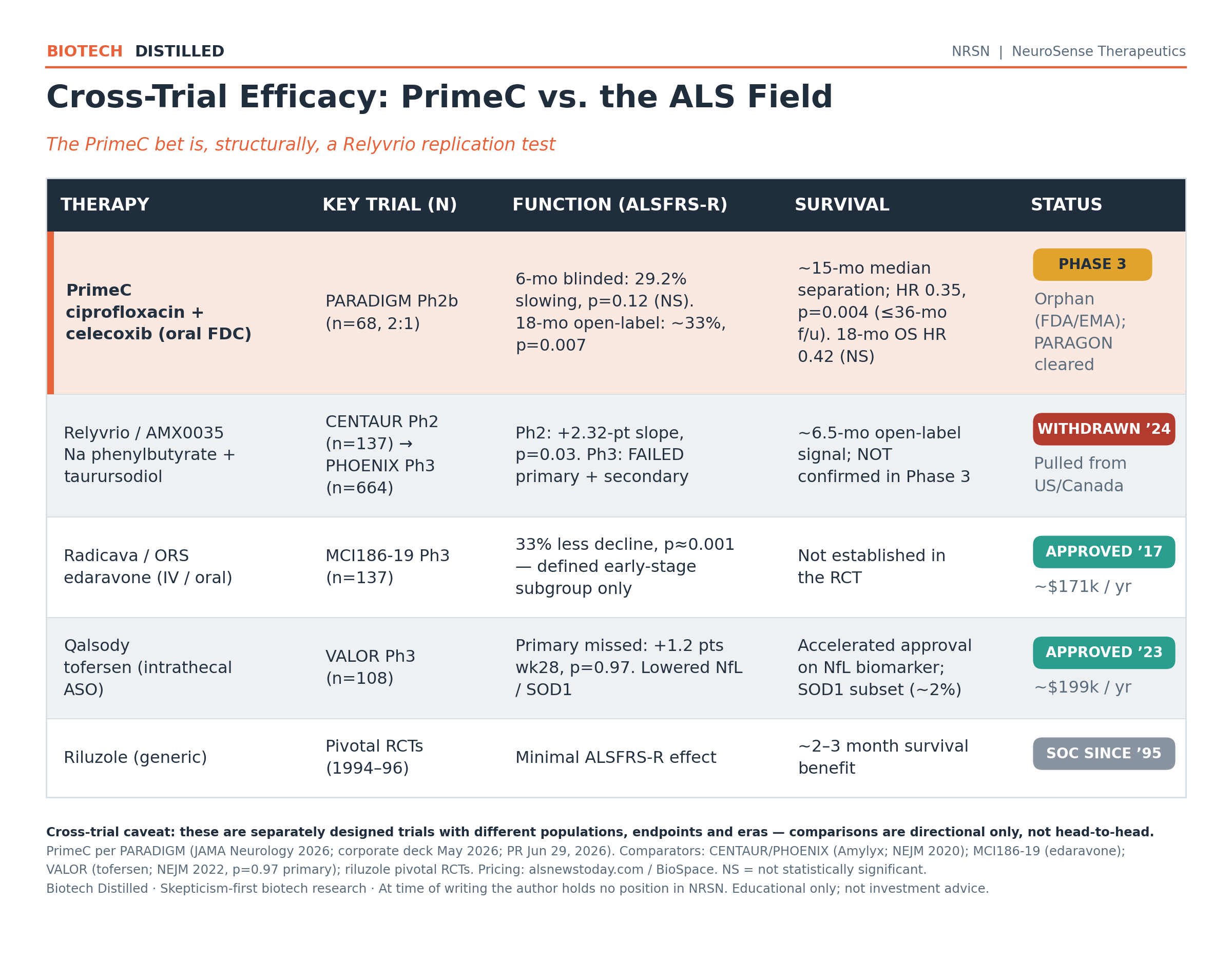
Against standard of care, the framing is favorable — riluzole buys ~2–3 months of survival and edaravone offers modest functional benefit in a subgroup — so a ~15-month median survival separation would be best-in-class if real. The problem is the “if.” Amylyx’s CENTAUR (n=137) showed a significant ALSFRS-R slope benefit (p=0.03) and a later ~6.5-month open-label survival signal, cleared the FDA, then failed PHOENIX (n=664) on both primary and secondary endpoints and was withdrawn. PrimeC’s Phase 2b is half the size of CENTAUR and its pre-specified 6-month clinical endpoint carried a higher p-value (0.12 vs 0.03).
The P-Hacking Check. Several receipts to keep honest:
Endpoint architecture. PARADIGM’s pre-specified primary endpoints were safety/tolerability and biomarkers; ALSFRS-R, SVC and survival were secondary. The June 2026 “met its primary efficacy endpoint” language reframes a co-primary biomarker (TDP-43) as the efficacy win, while the clinical numbers everyone cares about were secondary.
Significance migrates with time and design. The controlled 6-month ALSFRS-R and the 18-month overall-survival analyses were not significant (p=0.12; p=0.11). Significance appears in the open-label delayed-start comparisons and in up-to-36-month post-hoc follow-up (HR 0.35, p=0.004). Delayed-start separation can support disease modification — or reflect the healthier patients simply being the ones still alive to measure.
The denominator collapses. By Day 540, the “18-month” ALSFRS-R benefit rests on 8 placebo-arm patients vs 21 PrimeC (from 23 and 45). In ALS, dropout is death and progression; a mean computed on 8 survivors is fragile and survivorship-biased.
Serial reanalysis. The same 68-patient dataset has been press-released at least five times (Dec 2024, Feb 2025, Sept 2025, Feb 2026, June 2026), each slice adding an endpoint. That cadence keeps a nano-cap in the headlines; it also multiplies looks at one small dataset.
Safety / Tolerability — The Quiet Killers. PARADIGM’s safety was clean on its face: mostly mild-to-moderate, transient AEs, no ALSFRS-R-relevant TEAE differences over 18 months, and only two treatment-linked SAEs (transient, reversible). But the class-level questions for chronic dosing are real. Ciprofloxacin carries FDA boxed warnings for tendon rupture, peripheral neuropathy (which can be disabling and irreversible — and dangerously confounding in a motor-neuron disease population), QT prolongation, and aortic aneurysm/dissection, plus antimicrobial-stewardship concerns for years-long use. Celecoxib carries a boxed warning for cardiovascular thrombotic events. The FDA’s request for additional long-term ciprofloxacin tox data before chronic ALS use tells you the agency sees the same issue.
Data Integrity. PARADIGM was a legitimate randomized, double-blind, placebo-controlled, multicenter trial with balanced baseline prognostics (TRICALS, ALSFRS-R, background therapy) and independent publication in a top journal — a real credibility marker that separates NeuroSense from the average nano-cap. The limitations are size (n=68), the 6-month blinded window before open-label crossover, and heavy late attrition. Good trial; small trial.
Pipeline
PrimeC — ALS (Phase 3-ready). The whole company. FDA-cleared PARAGON, orphan drug (FDA + EMA), 505(b)(2), Canada NOC/c optionality. This asset is the valuation. Reality check: value driver, and the only one.
PrimeC — Alzheimer’s (RoAD, NST-AD-001). A Phase 2 exploratory POC that enrolled 8 participants, with 3 analyzable at 12 months; one SAB quote refers to “this first treated AD patient”. It reported directionally consistent movement in tau, Aβ42/40, α-synuclein and TDP-43. As biology, it’s a reasonable read-through of the shared-proteostasis thesis. As an asset, it is optionality bordering on placeholder — n=3 cannot be valued, and an “adequately powered” AD trial is unfunded and undesigned. No rare-pediatric angle, so no Priority Review Voucher to score into a sum-of-the-parts.
PrimeC — Parkinson’s. “Exploring potential co-development”. Zero-NPV placeholder until there’s a protocol and a partner.
Pipeline Verdict. One asset (PrimeC in ALS) carries 100% of the enterprise value. The AD and PD “programs” are mechanism-extension narratives that cost little and prove less; do not pay for them.
Intellectual Property & The Moat
The summary below is based on the 20-F filed by the Company in March 2026.
The moat is method-of-use plus formulation — there is no composition-of-matter patent of the actives, because the actives are generic. The company reports:
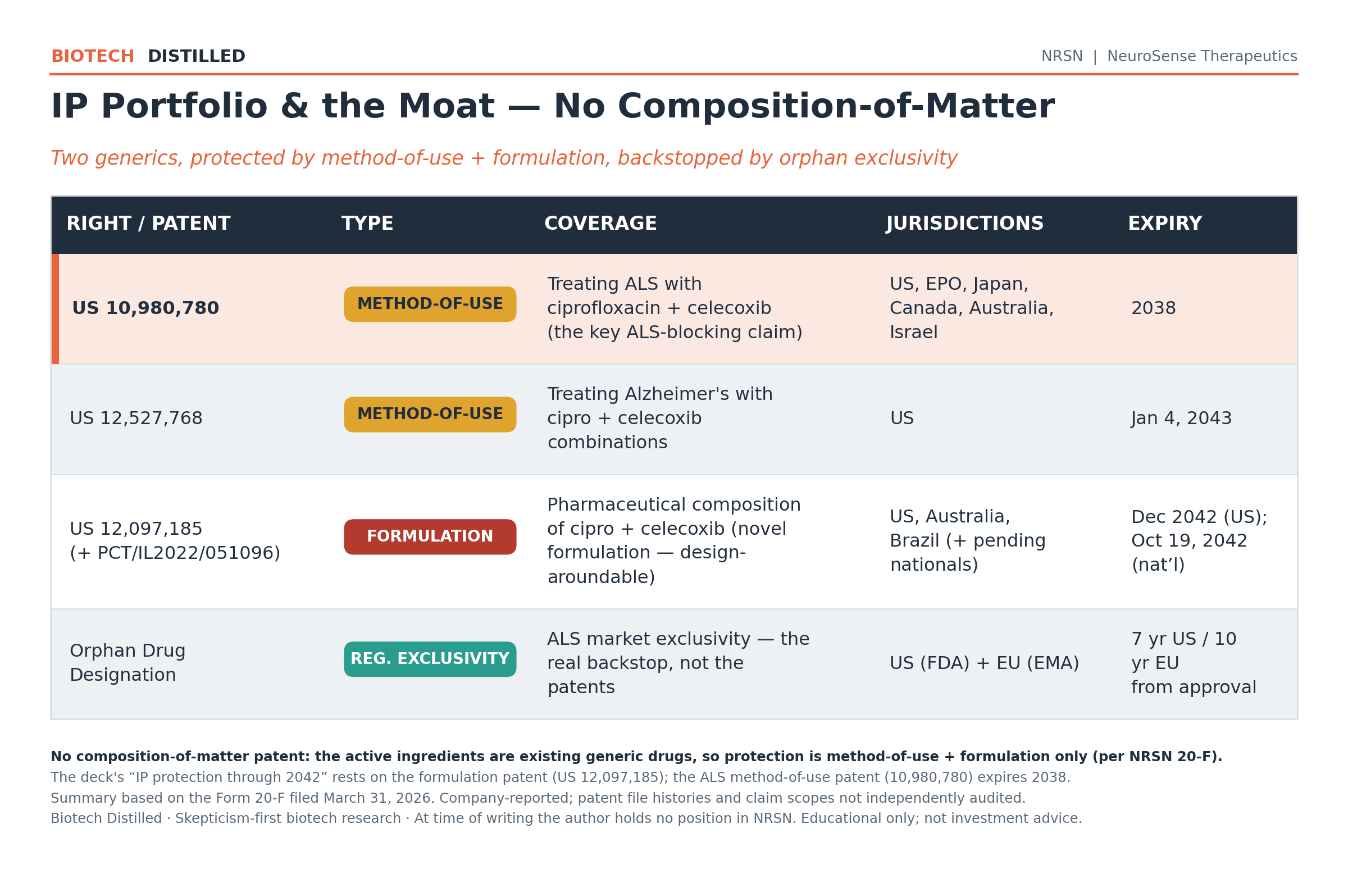
Asset-specific runway. The ALS method patent — the one that would actually block a competitor from treating ALS with this combination — runs to 2038. The deck’s headline “Robust IP protection through 2042” is carried by the formulation patent (12,097,185), potentially the weakest link in the chain: formulation claims around two generic drugs are often the most design-aroundable form of protection. A competitor (or a compounding pharmacy) could prescribe generic ciprofloxacin plus generic celecoxib off-label, or engineer a different fixed-dose release profile that avoids the formulation claims while delivering the same actives. NeuroSense says as much in its own risk factors.
The real backstop is regulatory, not patent. FDA and EMA orphan drug designation for ALS confers 7 years (US) / 10 years (EU) of market exclusivity on approval — for a repurposed combo, that orphan wall likely matters more than the patent estate. 505(b)(2) shortens the path but does not add exclusivity beyond orphan/NCE mechanics.
Competitive landscape.
The approved field is riluzole (generic), Radicava/edaravone (Mitsubishi Tanabe; global rights acquired by Shionogi in April 2026; ~$171,000/yr), and Qalsody/tofersen (Biogen/Ionis; ~$199,200/yr; restricted to the ~2% SOD1-genetic subset). None is a broad-population disease-modifier, which is the white space PrimeC targets — the same white space Relyvrio occupied and then vacated on withdrawal in 2024.
PrimeC is differentiated on convenience and mechanism (cheap oral, multi-target) but not on IP strength, and it would launch into a market that has just watched a structurally identical drug fail confirmation.
The Verdict
Scientific Conviction: Medium (biology) / Low (clinical durability). Coherent multi-target mechanism, real biomarker engagement including a first-of-kind TDP-43 reduction, and a JAMA Neurology publication — but the pivotal question rests on a 68-patient trial whose blinded clinical endpoint missed and whose closest analog just failed Phase 3.
Commercial Viability: Low (standalone). Even on approval: no composition-of-matter moat, generic-component design-around risk, chronic-fluoroquinolone safety overhang, zero commercial infrastructure, and $0.2M of cash.
M&A Appeal: Low-to-Medium. A binding term sheet with a global pharma that had completed due diligence collapsed in March 2026 when the counterparty deprioritized ALS — the single most informative data point about strategic appetite. Logical acquirers are thin post-Relyvrio: Biogen (owns Qalsody), Mitsubishi Tanabe/Shionogi (own Radicava). A clean PARAGON would revive interest; today’s tape says the phone isn’t ringing at a price that matters.
Trader Profile. Binary-event and deep-value speculators only — people sizing a lottery ticket on Canada NOC/c headlines or a partnership rumor. Not for compounders, and not for anyone who can’t stomach a reverse split and a dilutive raise inside the next two quarters.
Buy (speculative only).
Target audience: Risk-seeking spec-vestors who want asymmetric upside on an ALS disease-modifier in an empty market at a ~$26M cap.
Rationale: Peer-reviewed Phase 2b, orphan designations, FDA Phase 3 clearance, a real TDP-43 first, and a near-term Canada NOC/c catalyst — any partnership or non-dilutive financing could re-rate a micro-cap violently off a low base.
Execution: Size it as a lottery ticket you can lose entirely. The disciplined version is a small starter with pre-defined add points only after a financing overhang clears, and hard rules to trim any catalyst-driven spike into strength (buy the rumor, sell the news). Assume a reverse split.
Hold.
Target audience: Existing holders sitting on losses from higher levels (the stock IPO’d at $6.00; PIPEs have printed at $1.50 and $0.80).
Rationale: With the Nasdaq cure deadline (Sept 29, 2026), the Canada submission, and PARAGON initiation all clustered in H2 2026, the next two quarters are event-rich.
Execution: If you hold, consider holding into the Canada/partnership catalysts but keeping position size honest about going-concern and delisting risk; think twice before averaging down to defend a cost basis.
Sell / Avoid.
Target audience: Anyone who needs a fundable balance sheet or a durable moat.
Rationale: $0.2M cash, going concern, a Phase 3 it cannot self-fund, a collapsed pharma term sheet, formulation-grade IP, and the Relyvrio precedent. The most probable near-term path is dilution and/or a reverse split, both of which pressure the equity regardless of the science.
Execution: Avoid the common ahead of an all-but-certain capital raise; revisit only after the financing/partnership picture resolves.
Final Verdict
PASS. Genuinely interesting, peer-reviewed ALS biology wrapped around a near-terminal balance sheet running the exact repurposed-combo playbook that just failed confirmation — the financing and delisting risk dominates the science until proven otherwise. Tripwire to Watch List: a bona-fide strategic partnership or a Phase-3-sized non-dilutive/structured financing, and/or a positive Health Canada NOC/c decision. Absent those, treat PARAGON as unfundable and the equity as a dilution vehicle.
This report is strictly for informational and educational purposes only. It does not constitute financial advice, investment advice, or a recommendation to buy or sell any securities mentioned.
The scientific and clinical analyses herein should not be interpreted as medical guidance, diagnostic information, or treatment recommendations.
At the time of writing, the author does not hold a position in NeuroSense Therapeutics (NRSN).
Biotech investing is inherently volatile. Past scientific validation does not guarantee future clinical or regulatory success. Treat all clinical-stage biopharma allocations accordingly.
For informational and educational purposes only — not investment advice. The author's position (if any) is as stated in the original article. Always verify against primary sources and do your own due diligence.