
Moleculin Biotech (MBRX) - Scientific Deep Dive for Annamycin and Pipeline Products
Executive Summary
The Hook. Annamycin (naxtarubicin) replaces the basic amine (NH₂) common to every marketed anthracycline with a hydroxyl (OH), adds an iodine at C-2 and a 3’-deamination, and ships it in a multilamellar liposome — producing a net-neutral molecule at physiologic pH that stops binding cardiolipin, the mitochondrial phospholipid in heart muscle responsible for anthracycline cardiomyopathy.
The Bull Case. Anthracyclines appear in roughly half of all cancer treatments and are capped by a lifetime dose ceiling because they destroy hearts; remove the ceiling and you re-open the most effective cytotoxic backbone in oncology. Moleculin has dosed to a cumulative 2,970 mg/m² — 5x doxorubicin’s 550 mg/m² limit — with a mean change in left ventricular ejection fraction of −0.12% (95% CI −1.34 to 1.09; p=0.84) across 90 independently reviewed patients. Management sizes AML alone at ~$907M peak. Against an $11.9M market cap, that is a 50-bagger.
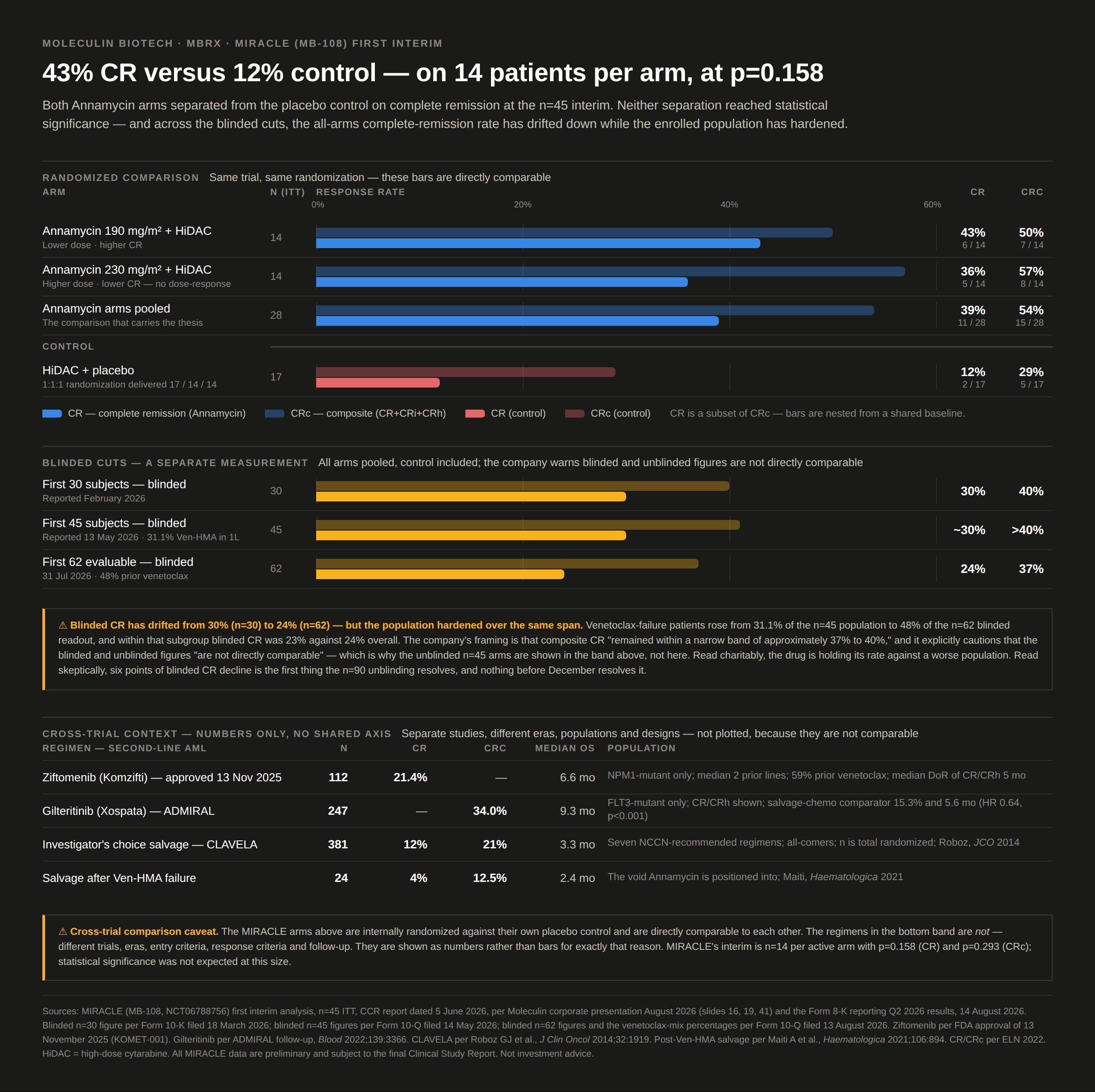
The Bear Case. Four things, any one sufficient. The pivotal interim is not significant: complete remission (CR — no detectable leukemia with full count recovery) of 43% and 36% in the Annamycin arms versus 12% control, at p=0.158 on 14 patients per arm. The blinded all-arms CR rate has drifted down — 30% at n=30 to 24% at n=62 — while venetoclax failures rose from 31.1% to 48% of the population. The composition-of-matter patent on Annamycin has expired, leaving formulation-level composition claims and orphan exclusivity as the entire moat. And the balance sheet carries going-concern doubt, $226.5M of accumulated deficit, a share count that went 3.2M → 19.5M in seven months after a cumulative 1-for-375 reverse split, 37.1M ratchet warrants struck at $0.75 with a $0.21 floor, and a stock below $1.00 since July 31, 2026 with no Nasdaq cure period available.
Bottom Line. The chemistry is real and the cardiac dataset is the most de-risked thing in the file. The equity is a different instrument: a $12M shell carrying a 37M-share ratchet, a delisting determination due within weeks, and an unfunded 222-patient Phase 3. You can believe in Annamycin and still not own MBRX. WATCH LIST.
Catalyst Calendar & Financial Runway
Upcoming Catalysts
~Mid-September 2026 — Nasdaq bid-price determination. Below $1.00 since July 31, 2026; thirty consecutive business days trips Listing Rule 5550(a)(2). Because the 1-for-25 reverse split closed December 1, 2025 — inside the trailing one-year window — the company is not eligible for the standard 180-day compliance period. Staff issues a delisting notice and the only recourse is a Listing Qualifications Panel appeal.
3Q 2026 — Breakthrough Therapy Designation request. The cheapest de-risking event available; silence past September is itself information.
September 2026 — Part A enrollment complete (n=90). The operative figure is 76 of 90 as of August 6, 2026.
December 2026 – February 2027 — the binary. Unblinded Part A n=90 readout and optimum dose selection. This is the whole equity.
~January 30, 2027 — variable-rate-transaction prohibition expires. The August 3 offering barred any “variable rate transaction” for 180 days. The filing does not define the term; on its standard formulation it captures an ATM, freezing the Roth facility until late January. That reading is mine, not the company’s.
1H 2027 — Part B start: 222 patients randomized 1:1 against HiDAC plus placebo, with 60 from Part A carried forward for a total Phase 3 n=282. Rolling NDA 2028; approval estimated 2030.
The Dilution Gap. Cash was $7.262M at June 30, 2026 against $9.313M of payables and accruals — negative net working capital before the raise — and the August 3 offering added ~$8.5M net, for pro-forma cash near $15.8M. Operating cash burn was $12.768M in the first half, about $6.4M a quarter, and that figure flatters the business because payables built $2.46M over the same period. Management guides to “into the first quarter of 2027.” So cash runs out in Q1 2027, the data lands December through February, and the ATM is frozen until roughly January 30. A raise before the readout is not likely — it is arithmetically required, and the only instrument available is a fixed-price offering priced off a sub-$1.00 stock. Part B is unfunded on top of that: an 18-month, 222-patient trial is a $60M+ program against $15.8M. The company says as much — “Moleculin will require significant additional financing, for which the Company has no commitments”.
The Ratchet. The August offering issued 12,376,667 shares and pre-funded warrants at $0.75 plus Series I warrants over 37,130,001 shares — three warrants per share — struck at $0.75 with full-ratchet anti-dilution down to a $0.21 floor. Any subsequent below-market issuance resets all 37.1M. The earlier tranches cannot absorb it: Series E, G and H already sit at their contractual floors of $3.00, $1.326 and $0.962— which is why the August deal needed a new tranche with a floor five-sixths below the last.
Insiders & Institutions. Shares went 3,199,228 → 19,477,380 between December 31, 2025 and August 6, 2026, and the 10-K notes a split-adjusted two-year range of $356.19 to $3.31 against $0.61 today. The only ≥5% holder on file is CVI Investments / Heights Capital Management at 9.9% (1,863,377 shares), 13G filed August 10, 2026 — one week after the deal, under a 9.99% blocker. Heights is Susquehanna International Group’s proprietary-capital arm — the signature of a warrant-structured deal buyer, not a fundamental holder. The rest is index and market-making flow — Vanguard, Geode, HRT Financial. No Fairmount, RA Capital, Perceptive, Deep Track, EcoR1 or Baker Bros. For a company claiming a pivotal Phase 3 with 43% CR, the absence of crossover money is the loudest datapoint in the file. Director Joy Yan resigned August 10, 2026, a week after the offering.
The Science: Mechanism & Chemistry
A small-molecule anthracycline analog in a multilamellar liposome, best classified as a bio-better: the innovation is chemical and formulation-level against the most validated target in cytotoxic oncology. Calling it a new chemical entity is pharmacologically defensible; calling it a patented NCE, as the deck does, is not necessarily accruate.
Mechanism Validation. As de-risked as targets get. Doxorubicin, daunorubicin, idarubicin and CPX-351 (Vyxeos) all work and all carry cumulative-dose cardiomyopathy — congestive heart failure in roughly 0.5% of patients at 150 mg/m², 3.75% at 450 and 8.25% at 600 (Swain, Cancer 2003). The only question is whether this one kills blasts without the heart damage.
Manufacturing / CMC Risks. Two single points of failure: “a single contract manufacturer to supply API and a separate single contract manufacturer for final drug product”. No China CMO exposure is disclosed, so BIOSECURE is not necessarily the issue — concentration is. The larger risk is geographic: a material portion of MIRACLE runs through Ukraine and Eastern Europe, where the trial was first approved and first dosed in early 2025.
Biochemical Deep Dive
The Target. Topoisomerase II relieves torsional stress during DNA replication; anthracyclines trap the enzyme–DNA cleavage complex, producing unrepairable double-strand breaks. In relapsed or refractory AML, patients arriving in second line have usually absorbed most of their lifetime anthracycline allowance during 7+3 induction. The most effective class is the one class you cannot re-dose, and across every approved pathway only about 38 of 100 AML patients reach a durable outcome.
The Chemistry. The 3’-amino group present on every marketed anthracycline is replaced by a hydroxyl, making the molecule net-neutral at physiologic pH rather than cationic — cardiolipin, the anionic phospholipid concentrated in cardiac mitochondrial membranes, recruits cationic anthracyclines electrostatically, and a neutral molecule has far less affinity. Iodine at C-2 adds mass and lipophilicity, and a multilamellar liposomal vesicle roughly 7-fold larger in volume than the API produces what the company calls organotropism — biodistribution favoring marrow, lung and pancreas over myocardium.
The pharmacokinetic consequence is underrated: terminal half-life of ~1–2 hours against ~20–48 hours for the doxorubicin class, so the heart’s integrated exposure is a fraction of doxorubicin’s even at higher peak doses. It also makes Annamycin a pulse agent — which is why durability, not response rate, is where this program will eventually be judged.
The Mechanism. The neutral lipophilic structure is reported to evade MDR1 / P-glycoprotein, the efflux pump that expels cationic anthracyclines from resistant blasts and drives acquired resistance in relapsed AML. That predicts non-cross-resistance with prior daunorubicin or idarubicin — the clinically important claim, since nearly every MIRACLE patient has seen an anthracycline. In a p53-null, FLT3-mutated murine model, median survival was 58 days for Annamycin plus cytarabine versus 34.5 for Annamycin alone, 17 for cytarabine and 14 for vehicle; every comparison involving Annamycin cleared p<0.0001, while cytarabine alone was indistinguishable from vehicle at p=0.6. That the combination beat monotherapy — the harder test — is the justification for pairing with cytarabine.
The Biomarker Receipts. The cardiac dataset is properly constructed: serial 12-lead ECGs, troponin I and T, and echocardiography with centralized global longitudinal strain analysis — GLS being the measure that detects subclinical myocardial dysfunction before ejection fraction moves. Ninety patients across five completed trials, 78 with source-verified paired LVEF, median cumulative dose 660 mg/m² (range 210–2,970), mean ΔLVEF −0.12% (p=0.84), no dose (p=0.12) or age (p=0.73) correlation, no patient meeting criteria for clinically significant LV dysfunction, adjudicated at the Cleveland Clinic. In the Bertazzoli assay, doxorubicin produced heart lesions in 100% of animals versus 0% for liposomal Annamycin. On efficacy biomarkers, MB-106 reported 75% of complete responders MRD-negative and 50% bridged to transplant — deep responses, on eight patients.
Bottom Line. The cardiotoxicity claim is the one part of this thesis with an n large enough to underwrite, and it matters commercially because it is the only thing that could make Annamycin a backbone rather than a salvage option. The efficacy claim runs on 14 patients per arm.
Clinical Data
Efficacy. MIRACLE (MB-108, NCT06788756) first interim, n=45 ITT, per the CCR report dated 5 June 2026:
The P-Hacking Check. Four flags.
The blinded CR rate is drifting down while the population hardens. Blinded, all arms pooled: CR 30% at n=30, ~30% at n=45, 24% at n=62; composite CR 40%, above 40%, then 37%. The company’s framing is defensible — CRc “remained within a narrow band of approximately 37% to 40%” — and it correctly cautions that blinded and unblinded figures “are not directly comparable.” The mix did harden: venetoclax failures went from 31.1% of the n=45 population to 48% at n=62, and within that subgroup blinded CR was 23% against 24% overall — so the drug may simply be holding its rate against a worse population. Six points of blinded CR decline is nonetheless the first thing December resolves, and nothing before then does. What is not ambiguous is the packaging: that release was headlined “Positive Interim Data with 37% Blinded CRc in Venetoclax-Failed Patients” — leading with the subgroup, not the falling all-comer CR — and a discounted offering priced the same day. The stock fell 63.5% to $0.88.
No dose-response on the primary endpoint. The lower dose gave the higher CR (43% vs. 36%) while the higher dose gave the higher CRc (57% vs. 50%). Crossed curves on two 14-patient arms is what noise looks like — and it complicates the Project Optimus dose selection that is the stated purpose of the n=90 readout.
Fragile denominators. Randomization was 1:1:1 but delivered 17/14/14, and the CR separation is four to six patients wide: two more control responders take that arm from 12% to 24% and the story evaporates. To the company’s credit, the deck prints p=0.158.
Subgroup-forward presentation. MB-106’s headline “50% CR / 60% CRc” is the n=10 second-line subset of an n=22 all-comers trial whose full-cohort numbers are 36% / 41%; the venetoclax-failure claim of “40% CR and 60% CRc” is n=5. Using the 2L subset is defensible since MIRACLE is a 2L trial. Leading with n=5 against a competitor’s n=14 is not.
Safety — The Quiet Killers. Non-cardiotoxic is not non-toxic. In MB-106, Grade ≥3 treatment-emergent adverse events occurred in 21 of 22 subjects (95.5%): hemoglobin decreased 45.5%, platelets 40.9%, pneumonia 22.7%, neutrophils 18.2%, febrile neutropenia 13.6%. MB-105 monotherapy (n=20) ran neutropenia 80%, thrombocytopenia 75%, anemia 75%.
The real quiet killer is myelosuppression-driven infection, and management’s handling of it is the tell. The deck footnotes on-study infection deaths with “subject succumbed to an infection that, upon review, could have been avoided with proper standard of care infection prophylaxis” and “subjects did not receive SOC for infection and succumbed to infection”. Neither the deck nor the 10-K gives a count, which is itself the problem. It may be accurate site-conduct reporting; it is also exactly how a sponsor writes an on-study death out of the drug’s column, and on an n=22 dataset each one is 4.5% of the trial. Doxorubicin’s boxed warning covers cardiomyopathy, secondary malignancy and extravasation necrosis; Annamycin plausibly clears the first and third while inheriting the class’s marrow suppression in full.
Data Integrity. MIRACLE is the structural good news: randomized, double-blind, placebo-controlled, ITT with no exclusions, an independent DMC and a third-party CRO — a legitimate pivotal design and a material upgrade on this company’s history. The supporting evidence is not: MB-106 was open-label, single-arm, n=22, and its complete responses came from 4 sites in 2 countries, Poland and Italy — zero US responders in the trial that generated the headline efficacy.
Pipeline
Annamycin — R/R AML (MIRACLE) · Phase 2B/3. Orphan Drug and Fast Track. Primary endpoint is CR after a single cycle at ~35 days per FDA guidance from the end-of-Phase-1B/2 meeting; OS secondary. FDA restricts the label’s reach: FLT3-positive patients excluded in 2L unless a FLT3 inhibitor is inappropriate or unavailable, prior anthracycline exposure capped under 200 mg/m². Management estimates initial labeling still covers 70–80% of 2L AML. This is 100% of the value.
Annamycin — STS Lung Metastases (MB-107) · Phase 1B/2 complete. Orphan Drug and Fast Track. n=36, RP2D 330 mg/m², median OS 13.5 months in a median seventh-line population, against a meta-analysis of 10 studies and 2,267 subjects reporting 8–12 months for second-line standard of care and 13.4 months for second-line experimental agents (Comandone, The Oncologist 2017). Seventh-line survival matching the second-line experimental benchmark is a genuinely interesting signal — but the company only “expects to identify next phase of development in near term,” which translates to unfunded and parked. Optionality, not value.
Annamycin — pancreatic, pediatric AML, 3L AML. All investigator-initiated or planned-and-unfunded: an Atlantic Health third-line pancreatic Phase 1b/2 expected 2H 2026, a UNC preclinical agreement, pediatric and 3L AML pencilled for 2027. Zero-NPV placeholders at current cash.
WP1066 — p-STAT3 inhibitor · Phase 1/2, externally funded. Northwestern runs an investigator-initiated Phase 2 with radiation in glioblastoma, 7 patients dosed; Emory is evaluating IV reformulations, data expected 2H 2026. Moleculin supplies drug. Critically, WP1066 carries Rare Pediatric Disease Designation for ependymoma, DIPG, medulloblastoma and ATRT, and the RPD priority review voucher program was reauthorized February 3, 2026 through September 30, 2029, with vouchers historically transacting above $100M. Call that a theoretical ~$100M SOTP option — but it needs an approved NDA from an asset the company does not fund, whose US composition patents date from a December 2004 filing and are at or past base term. Real optionality, effectively unreachable on this balance sheet.
WP1122 — antimetabolite. Glucose-metabolism inhibitor for GBM and virology, with Orphan Drug and Fast Track. In October 2025 the company took options to license — not licenses — on WP1122 and a new WP1066 formulation, tied to continued MD Anderson sponsored research. Placeholder.
Pipeline Verdict. Annamycin in R/R AML carries the entire valuation, and specifically the December–February unblinding. A single-asset, single-date binary.
Intellectual Property & The Moat
The summary below is based on the 10-K filed by the Company in March 2026 and the 10-Q filed in August 2026.
The headline finding. Everything is licensed from MD Anderson, with several patents co-owned with The University of Texas System Board of Regents by virtue of co-inventorship. And the 10-K risk factors state, without qualification: “The composition of matter patent for Annamycin has expired,” adding that “competitors may be able to offer and sell products so long as these competitors do not infringe any other patents that third parties or we hold”. The deck, meanwhile, calls Annamycin a “Patented NCE” and records that the USPTO “awards composition of matter patent to Annamycin (coverage thru 2040)”. Both describe the same four patents. The API’s original protection — the molecule itself, taken into the clinic by Aronex and Callisto before rights returned to MD Anderson — is dead; what issued in 2024–2025 are composition claims to formulated product, a materially narrower thing than a patent for the molecule itself.
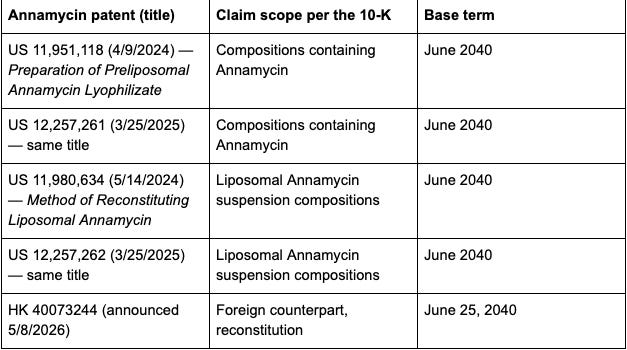
Note the claim scope: despite process-flavored titles, all four carry composition claims — stronger than a pure process estate, weaker than composition-of-matter on the molecule. The honest read: the moat is a formulation estate plus orphan exclusivity, not a molecule. Orphan Drug Designation in AML delivers 7 years of US exclusivity from approval and 10 in the EU; NCE exclusivity, if FDA treats naxtarubicin as a new molecular entity, runs 5 years from that same date and is subsumed by the orphan period rather than added to it. On a 2030 approval, orphan runs to 2037 — behind the 2040 formulation patents, which is the right way round. But with composition-of-matter gone, a competitor formulates around four liposomal-composition claims rather than inventing around the molecule. For a hard-to-make multilamellar liposome that is a real barrier. It is not the barrier “Patented NCE” implies.
Ownership & licensing. Nothing is wholly owned. MD Anderson milestones run as high as $0.5M for Phase II/III commencement and $0.6M for NDA submission and first approval, with single-digit royalties. The sponsored research agreement runs only to March 31, 2027 and “is expected to be extended, however there can be no assurance” — and the October 2025 options on WP1122 and the new WP1066 formulation are expressly tied to continued sponsored research there. Let the SRA lapse and the option pipeline lapses with it. One related-party structure to name: in 2019 Moleculin sublicensed non-human animal rights across all three programs to Animal Life Sciences, affiliated with founder Dr. Waldemar Priebe, for the MD Anderson royalty rate plus 5% of net sales and a 10% equity stake.
Competitive Landscape. Second-line AML is crowded but commercially unimpressive, and that cuts both ways — Revuforj (revumenib, Syndax) is the momentum asset at $54.7M net revenue in Q2 2026, up 91% year over year. The instructive comparison, though, is Vyxeos, the liposomal anthracycline-plus-cytarabine product payers explicitly anchor Annamycin’s pricing against. Jazz paid ~$1.5 billion for Celator in 2016 to acquire it, and Vyxeos did $162.6M in 2024, $146.7M in 2025, and $58.0M in H1 2026 against $74.4M a year earlier — a 22% decline. The closest approved analog peaked near $163M and is shrinking, so Moleculin’s $907M AML base case — 25% share of 2L R/R at $30,000 per infusion US and $15,000 ex-US — is roughly 6x what the comparable product ever achieved. AML is a small, inpatient, DRG-constrained market. That number gets haircut first.
The Verdict
Scientific Conviction: Medium-High. The cardiolipin-avoidance design is sound medicinal chemistry, and the 90-patient independently adjudicated cardiac dataset is the rare small-cap claim that survives scrutiny. The efficacy claim is 14 patients per arm at p=0.158.
Commercial Viability: Low-Medium. Even a clean approval lands where the closest approved analog does ~$120M annualized and is shrinking, with FDA-imposed label restrictions on FLT3-positive patients and prior anthracycline exposure.
M&A Appeal: Medium — and the most realistic exit. Jazz is the obvious acquirer: it already owns the liposomal-anthracycline AML franchise, is watching it decline, and paid $1.5B for that position once. Servier, Astellas, AbbVie and Kyowa Kirin all have AML infrastructure to leverage. At a $12M market cap the whole company costs less than one Phase 1 trial — but a buyer will wait for the n=90 unblinding.
Trader Profile: Binary-event gamblers and distressed-microcap specialists only. Not necessarily a compounder or a momentum name, and the delisting risk makes it uninvestable for anyone with a mandate.
Buy
Target Audience. Binary-event speculators sizing to zero, and event-driven funds able to underwrite an equity that may reprice through a warrant ratchet.
Rationale. An $11.9M enterprise on a drug showing 39% pooled CR against 12% control in a randomized, blinded, placebo-controlled pivotal, where the approved competition delivers 21% CR in a mutation-restricted subset. If CR separation holds at n=90 with p<0.05, this is a rolling-NDA accelerated-approval story and a $12M market cap is absurd.
Execution. Sizing is the entire trade: consider treating it as a total-loss lottery ticket. Common only — the Series I warrants put deal buyers structurally ahead of you on any raise. Think twice before selling puts: with a delisting determination pending and a financing required before the data, you would be short a gap that has already happened once (−63.5% on July 31). Consider waiting for either a completed post-lockup financing (after ~September 17) that clears the balance sheet into the readout, or a Nasdaq panel outcome that removes the listing overhang.
Hold
Target Audience. Existing holders already deep underwater — which, given the 10-K’s own two-year range of $356.19 to $3.31 against a $0.61 close, is essentially all of them.
Rationale. The loss is taken. What remains is a call option on a dated event four to six months out, and the question is whether expected dilution destroys more value than the readout creates. Selling at $0.61 into an $11.9M market cap is selling that option for nearly nothing.
Execution. Consider holding the residual, adding nothing, and setting the exit on process rather than price: if the company raises below $0.75 — resetting 37.1M Series I warrants toward the $0.21 floor — a good readout stops producing a good outcome for existing equity. That is the sell signal, not the stock price. Second trigger: a Nasdaq panel denial.
Sell
Target Audience. Anyone who owns this on the strength of a press release, and any institution with a listing-standard or liquidity mandate.
Rationale. Four compounding structural problems, independent of whether the drug works. (1) A delisting determination due within weeks with no cure period available. (2) A financing required before the data, into a sub-$1.00 stock, with the ATM frozen until roughly January 30, 2027. (3) A 37.1M-share ratchet that converts any rescue financing into a step-function jump in share count. (4) A blinded CR rate drifting from 30% to 24%, so the base rate for a disappointing December is higher than the interim headline suggests.
Execution. Consider exiting into strength — this name produces violent single-day rallies on press releases, and those are the liquidity. Think twice before shorting it: borrow on a $12M float is expensive and unreliable, squeeze risk on a positive December readout is enormous, and the downside is capped at a value already near zero.
Final Verdict
WATCH LIST. The chemistry clears the bar and the cardiac dataset is genuinely de-risked, but a delisting determination with no cure period, a required pre-data financing, and a 37.1M-share ratchet mean the equity may not survive to collect on the one catalyst that matters. Revisit only after both the n=90 unblinding and a financing that does not reset the Series I floor.
This report is strictly for informational and educational purposes only. It does not constitute financial advice, investment advice, or a recommendation to buy or sell any securities mentioned.
The scientific and clinical analyses herein should not be interpreted as medical guidance, diagnostic information, or treatment recommendations.
At the time of writing, the author does not hold a position in Moleculin Biotech, Inc. (MBRX).
Biotech investing is inherently volatile. Past scientific validation does not guarantee future clinical or regulatory success. Treat all clinical-stage biopharma allocations accordingly.
For informational and educational purposes only — not investment advice. The author's position (if any) is as stated in the original article. Always verify against primary sources and do your own due diligence.